Can Artificial Intelligence be used to gain an investment edge in peer-to-peer lending?
A condensed, mobile-readable version of the full case study.
The question
- P2P lending platforms bucket and grade borrower applications based on the borrowers' risk profile i.e. the predicted ability to repay the loan.
- More than a 100 parameters are used to adjudge a borrower's application. These range from credit score (FICO) and debt-to-income ratio (DTI) to home ownership status, monthly income, and credit card utilization data.
- A borrower's risk grade determines the interest rate on their loan.
The baseline returns gap
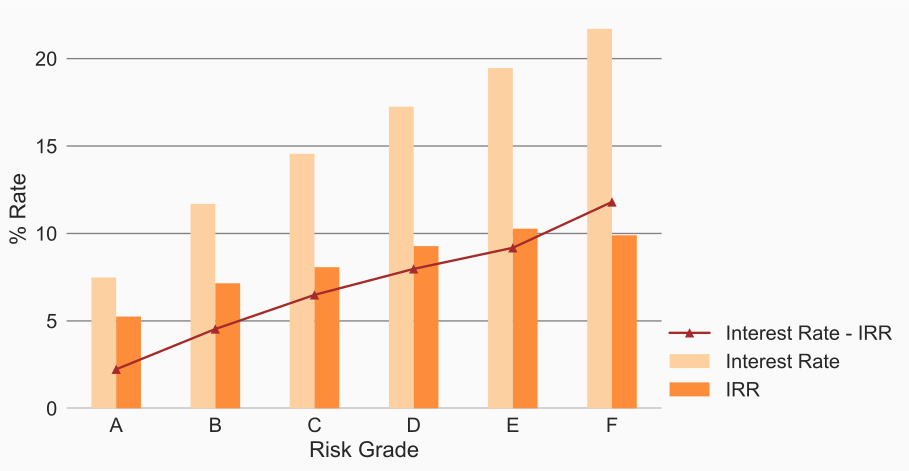
- We present IRRs for all loans made by a large P2P platform between 2007 and 2012.
- Investors garnered annualized returns of 5% to 10%, generally with a higher return for higher risk.
- While the gap between the APR on the loans and the IRR realized by investors increases with a worsening in grade, no grade is immune to the effects of charge-offs.
- This chart serves as a baseline for our analysis, as we look to narrow this gap in returns, across grades.
- Our goal is to utilize machine learning and AI to construct a superior portfolio that will outperform these baseline IRRs.
The machine learning approach
Dataset scale
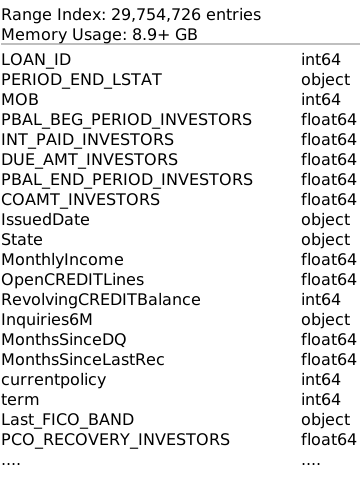
- Since the beginning of the decade, the P2P platform we analyze has issued more than 1.6 million loans.
- Between application data from the borrower and data pulled from credit bureaus and other third parties, we have access to more than 150 fields of data per loan.
- We have nearly 30 million rows of time series data detailing month-by-month payment history of every loan.
Model comparison
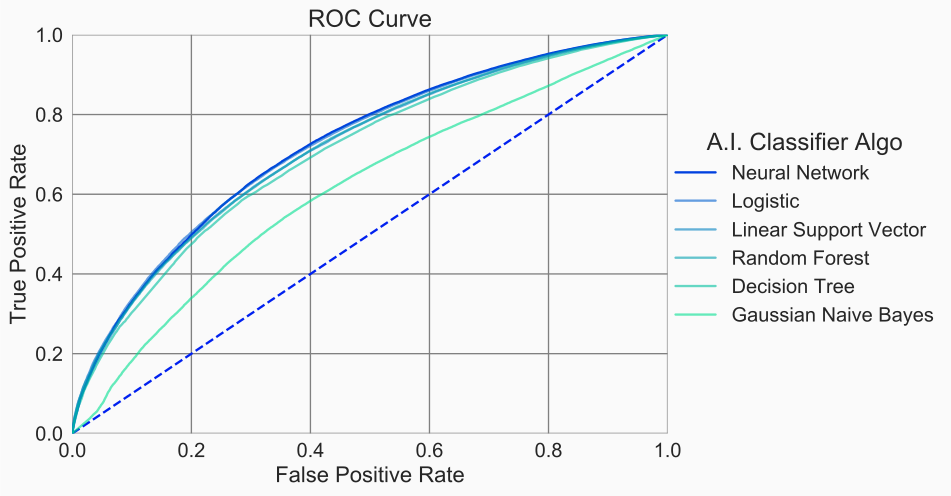
- We construct a 1,000+ dimensional dataset to train our binary classifier.
- We run and evaluate various algorithms including Gaussian Naive Bayes, Support Vector Classifier, Decision Tree, Random Forest, Logistic Regression and several Deep Neural Networks.
- In the associated chart, the Deep Neural Network shown was the best predictor, while the Gaussian Naive Bayes was the worst.
- The dashed line (an AUC of .5), represents the baseline to benchmark against. In other words, a model with this performance will make us buy all loans originated (or a representative sample), leading to returns that would mirror the overall platform experience.
Evaluation method
- The general approach was to train the model on a random subset of loans (training set) and search the hyperparameter space for the best settings using cross-validation. The results were then evaluated on unseen loan data (test set).
- Learning is performed on the training data while hyperparameters are tuned using the cross-validation set. The (out of sample) test set is used for the evaluation of model efficacy.
What mattered most
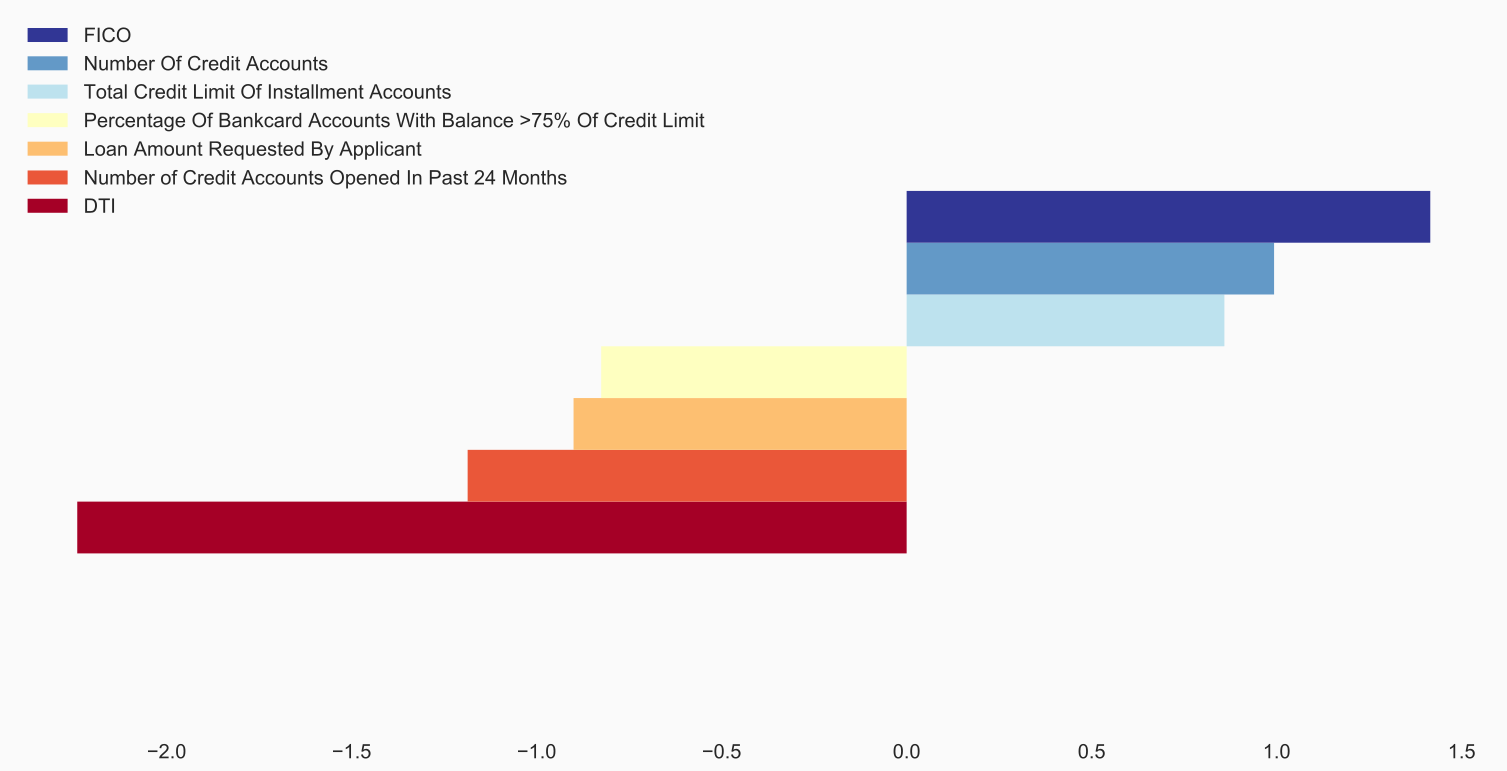
- Of the parameters we show, debt-to-income ratio (DTI) was the most powerful in explaining default performance, followed by FICO.
- Besides FICO, number of credit accounts and total credit limit were positively correlated with performance. Parameters related to a recently heavier need and use of credit were negatively correlated.
Results
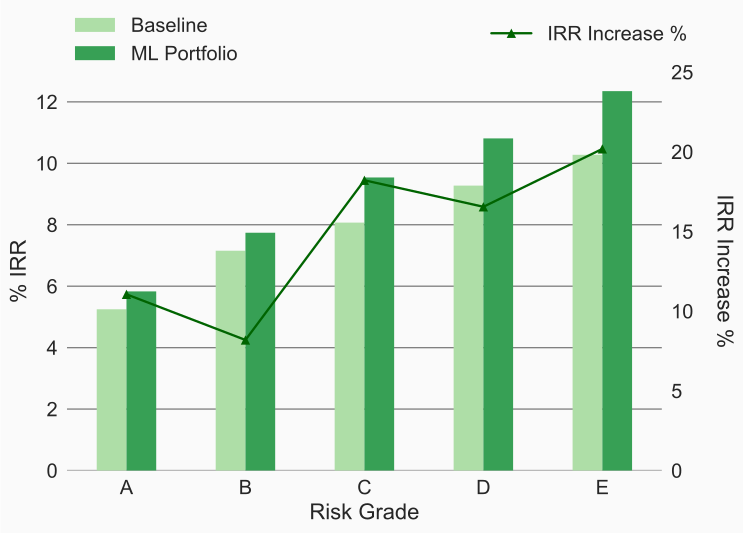
- Here, we present the returns generated on an out-of-sample portfolio by a binary classifier.
- We use the same vintages as previously presented to compare apples to apples.
- As can be seen, this portfolio outperformed the baseline returns by 8% to 20%+, with more outperformance for riskier grades.
- The returns (and outperformance) are dependent on the portfolio strategy implemented. The strategies, depending on the mandate, could be as diverse as targeting a certain proportion of overall production or production by grade or equal portfolio-weighting by grade or more actively managed strategies, etc.
Assumptions & caveats
- Backtesting results are presented on out-of-sample data from 2007-2012 vintages.
- We only report results where our algos were able to select at least 500 loans (± small tolerance) for a portfolio given the constraints we overlay.
- The basic investment strategy is benchmarked to baseline IRRs. In other words, it is a 'relative value' strategy.
- We are not aware of the existence of any efficient mechanism to sell a baseline portfolio as a hedge against our artificial intelligence-based portfolio. This ties our fate, to a certain degree, to the overall sector's performance.
- We are also unsure of the volume and efficiency of trading peer-to-peer loans on secondary exchanges. Effectively, the strategy is a 'hold to maturity' strategy.
- The returns presented here are gross, unlevered returns.
The full case study, with every chart and the complete commentary, is laid out for larger screens.
Read the full case study